
2026 Top Slatwall Accessories Guide for Global Buyers
Global buyers need more than hooks, shelves, and attractive display photos. They need evidence, compatibility, and practical installation details. This 2026 Slatwall Accessories Guide examines those decisions across retail, hospitality, and commercial interiors.
Grand View Research’s retail shelving market analysis identifies modularity, space efficiency, and flexible merchandising as continuing market drivers. Deloitte’s Global Powers of Retailing reports also emphasize physical stores as experience-led environments, not simple transaction spaces. These findings matter when choosing brackets, baskets, face-outs, bins, and lockable showcases. A weak accessory can leave unused holes, uneven spacing, or visible stress around a panel. Small defects become expensive across hundreds of stores.
Retail analyst Paco Underhill offers a useful warning: “The first thing you need to know about shoppers is that they don’t know what they want.” His observation in Why We Buy supports a buyer-focused approach to fixture planning. Accessories must guide movement and make products easy to touch, compare, and understand.
This guide compares load ratings, finish durability, panel compatibility, packaging, and replacement support. It also considers metric and imperial dimensions, because a few millimeters can disrupt a global rollout. Supplier claims should be checked against drawings, samples, and installation tests. Not every “universal” fitting is truly universal. That deserves scrutiny.
Real store conditions are messy. Dust collects beneath shelves. Heavy cartons test every bracket. Staff change layouts quickly. Reliable accessories should survive those moments while preserving a clean presentation. The best specification is not always the most expensive one. It is the one that performs consistently, ships securely, and remains serviceable in different markets.
What Slatwall Accessories Are and Why They Matter in 2026
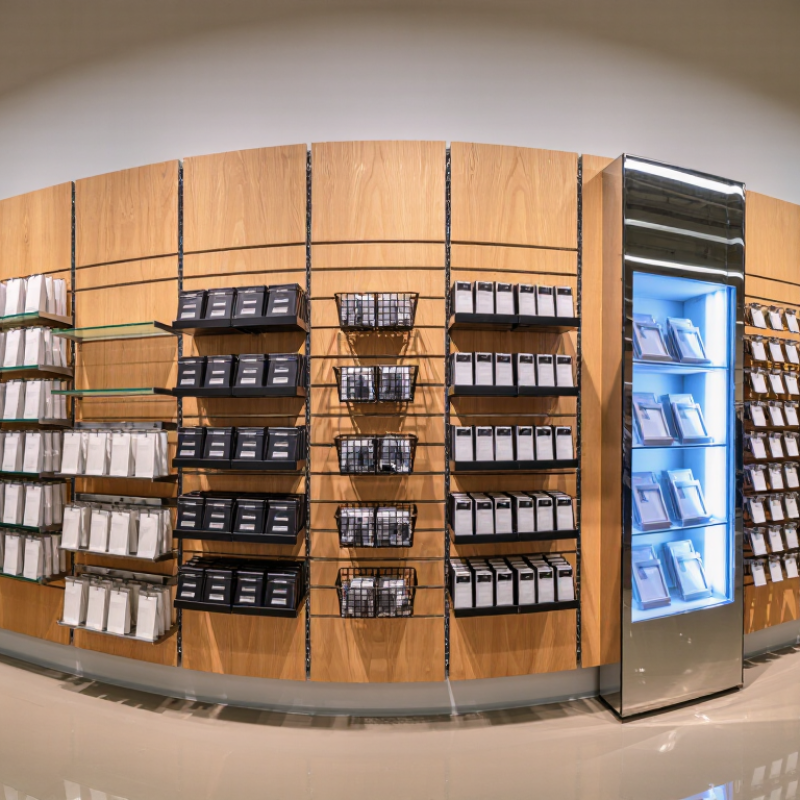
Slatwall accessories are the working parts of a slatwall display. They include shelves, hooks, baskets, brackets, sign holders, and lockable fixtures. The panel is only the framework. Accessories decide how products sit, face shoppers, and move through a store.
In practical retail projects, buyers usually value tool-free adjustment. A shelf moved 100 millimeters can prevent crowded packaging or improve hand access. Hooks support hanging goods, while baskets handle small, loose items near eye level. Fit is not universal. Groove spacing, material thickness, load capacity, and finish can vary across suppliers, even when panels look similar. Global buyers should request drawings, tested load data, corrosion information, and replacement-part availability before placing volume orders. Those details are less visible, but they often control installation cost.
The 2024 NRF and Appriss Retail report estimated that U.S. shoppers returned about 16.9% of annual retail sales, worth nearly 890 billion dollars. Flexible accessories can help stores reconfigure returned, seasonal, or redistributed stock without rebuilding the wall. Deloitte’s 2024 Global Powers of Retailing report also highlights continuing pressure on retailers to improve efficiency across physical and digital channels. That pressure makes modular displays commercially useful in 2026. Still, flexibility can be overstated. Weak hooks bend, glossy finishes show scratches, and mixed components may create an uneven appearance. Small parts matter. Buyers should test a complete sample bay, not only approve a product photograph.
2026 Top Slatwall Accessories Guide for Global Buyers - What Slatwall Accessories Are and Why They Matter in 2026
| Accessory Type | Primary Retail Function | Common Materials | Typical Size Range | Indicative Load Capacity | Best-Suited Merchandise | Buyer Considerations for 2026 |
|---|---|---|---|---|---|---|
| Single-Prong Hook | Creates compact hanging points for individually packaged or lightweight products. | Powder-coated steel, chrome-plated steel, or stainless steel. | Projection: 75–300 mm; wire diameter: commonly 4–8 mm. | Approx. 3–10 kg | Accessories, tools, small packaged goods, stationery, and hardware. | Confirm groove compatibility, hook retention, corrosion resistance, and whether a stop tip is required. |
| Multi-Prong Hook | Uses several projecting arms to increase product density on one slatwall position. | Steel wire or formed steel with powder coating or plating. | Projection: 150–300 mm; usually 2–5 arms. | Approx. 5–15 kg | Blister packs, cables, small tools, craft items, and consumer accessories. | Useful where facing density matters; check center spacing and the total weight of all products placed on the hook. |
| Shelf with Brackets | Provides a horizontal display surface for boxed, loose, or folded merchandise. | Tempered glass, melamine-faced board, MDF, plywood, or powder-coated steel. | Depth: 200–450 mm; length: commonly 600–1,200 mm. | Approx. 15–60 kg | Home goods, electronics packaging, footwear, books, and folded apparel. | Load capacity depends on shelf material, bracket spacing, panel strength, and how far the shelf projects from the wall. |
| Waterfall Garment Arm | Displays garments in a stepped arrangement so shoppers can view individual items easily. | Steel tube or solid steel with powder coating, chrome, or satin finish. | Projection: 300–500 mm; commonly 5–8 stepped positions. | Approx. 10–25 kg | Shirts, jackets, dresses, trousers, and coordinated apparel collections. | Evaluate arm diameter, end stops, spacing between garments, finish durability, and resistance to repeated loading. |
| Straight Garment Rail | Supports hangers in a continuous row for high-capacity apparel presentation. | Steel or aluminum tube with powder coating, anodizing, or plating. | Projection: 250–400 mm; length: commonly 600–1,200 mm. | Approx. 20–45 kg | Hanging apparel, uniforms, workwear, and seasonal clothing. | Check rail deflection, bracket spacing, hanger clearance, panel reinforcement, and the required end stops. |
| Faceout Arm | Positions one or more garments facing forward to highlight a key product or size range. | Steel rod or tube with powder coating, chrome, or stainless steel finish. | Projection: 150–350 mm; commonly 1–5 hanger positions. | Approx. 5–15 kg | Featured apparel, premium garments, coordinated outfits, and promotional items. | Prioritize anti-slip end details, stable mounting, suitable projection, and a finish that tolerates frequent handling. |
| Wire Basket | Holds loose or irregularly shaped merchandise while keeping contents visible. | Welded steel wire with powder coating or plating. | Width: 300–600 mm; depth: 200–400 mm; height: 100–300 mm. | Approx. 8–25 kg | Soft goods, toys, packaged food, accessories, and clearance merchandise. | Look for rounded wire edges, easy cleaning, appropriate mesh openings, and sufficient front access for shoppers. |
| Plastic or Acrylic Bin | Provides organized, front-access storage for small products and impulse items. | ABS, polycarbonate, PETG, or acrylic sheet. | Width: 150–400 mm; depth: 150–350 mm; height: 100–250 mm. | Approx. 3–12 kg | Cosmetics, packaged accessories, small parts, stationery, and promotional goods. | Compare impact resistance, transparency, UV stability, cleaning requirements, and compatibility with metal brackets. |
| Sign Holder | Displays price cards, product information, promotions, or category navigation directly above merchandise. | Clear acrylic, PETG, polycarbonate, aluminum, or steel. | Card formats commonly range from A6 to A4; projection: 50–250 mm. | Light-duty accessory | Price labels, product specifications, sale messages, and wayfinding signs. | Confirm viewing angle, card replacement method, print format, glare control, and resistance to cracking during transport. |
| Pegboard Adapter | Connects selected pegboard hooks or holders to a slatwall panel system. | Formed steel, injection-molded engineering plastic, or zinc-coated steel. | Adapter projection: commonly 50–150 mm; hole spacing varies by pegboard system. | Approx. 3–10 kg | Small packaged products, tools, craft supplies, and display components. | Compatibility is system-specific; verify peg diameter, hole spacing, locking method, and load transfer before ordering. |
| Mirror or Display Panel Holder | Supports mirrors, graphic panels, or decorative merchandising elements on the slatwall. | Steel, aluminum, rubber-lined clamps, or engineered plastic. | Designed for panel thicknesses commonly between 3–10 mm. | Application-specific | Fitting-room support, eyewear displays, visual merchandising, and informational panels. | Check panel thickness, safety retention, edge protection, anti-tilt features, and the combined weight of the holder and panel. |
| Shelf Divider | Separates product groups on a shelf and maintains neat front-facing presentation. | Clear acrylic, PETG, polycarbonate, wire, or coated steel. | Height: 75–250 mm; depth: commonly 200–450 mm. | Light-duty accessory | Books, packaged goods, footwear, folded apparel, and boxed merchandise. | Choose a divider height that preserves visibility; rounded edges and tool-free adjustment improve store safety and flexibility. |
Purchasing note: Dimensions and load figures are typical planning ranges rather than universal specifications. Actual performance depends on groove spacing, panel construction, mounting hardware, bracket geometry, material thickness, installation quality, and evenly distributed loading. Buyers should request technical drawings, test reports, finish specifications, packaging details, and regional compliance documentation before placing a bulk order.
Related Posts
-
China Best Entryway Storage Systems Manufacturers?
-
2026 Top Overhead Garage Storage Solutions for Space Saving Efficiency?
-

How to Choose the Best Closet Lighting Ideas?
-

10 Best Tips for Decluttering Your Home Effectively?
-

Top 5 Cabinet Hardware Trends You Need to Know Now?
-

How to Organize Your Space with Creative Shoe Storage Ideas?