Choosing the right Epoxy Garage Flooring can feel simple until real garage conditions appear. Hot tires, road salt, oil drips, concrete dust, and sudden temperature changes test every coating. A glossy finish may look excellent in a showroom. It may fail when moisture rises through an unprepared slab.
Bob Harris, a respected decorative-concrete educator, has emphasized, “Proper preparation is the key to a successful coating.” That principle remains practical for global buyers. A garage in Canada may need cold-temperature performance, while a coastal property may require stronger moisture resistance. Buyers should also examine resin content, curing time, slip resistance, UV stability, maintenance needs, and local installation conditions.
No system is perfect.
This guide introduces the top 10 types of Epoxy Garage Flooring, including solid-color coatings, decorative flake systems, quartz broadcasts, metallic finishes, water-based epoxies, solvent-based formulas, and high-solids options. Each type offers a different balance of appearance, durability, cost, and installation complexity. Some systems hide tire marks well. Others create a brighter, more spacious appearance. A few demand professional surface preparation and controlled application temperatures.
The comparisons will focus on practical use, not marketing language alone. We will consider concrete moisture, crack repair, primer selection, aggregate texture, curing schedules, and everyday cleaning. Still, product labels can be incomplete, and regional standards vary. That weakness deserves attention. Independent testing and advice from qualified flooring professionals remain valuable before purchase. A beautiful floor is useful only when it survives the garage it serves.
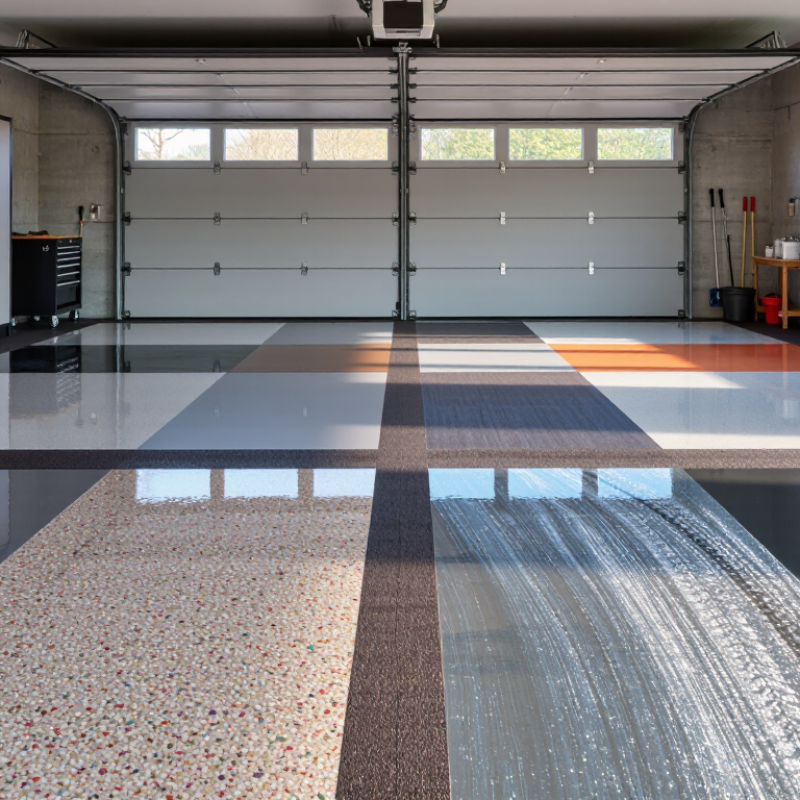
Epoxy garage flooring begins with resin chemistry, not color selection. A resin component reacts with an amine hardener and forms a dense crosslinked film. Mixing ratios matter. Too much hardener can leave a brittle surface, while poor mixing creates soft patches. Temperature and humidity also change curing speed. A cool slab may look dry but still hold moisture beneath the coating. That hidden moisture can cause blistering later.
ASTM D638 measures tensile properties using a shaped plastic specimen. Test reports may show tensile strength, tensile modulus, and elongation at break. These figures help compare cured epoxy formulations.
However, they do not predict every garage result. A real floor faces tires, grit, impact, thermal movement, and concrete cracks. A garage floor is not a dumbbell-shaped specimen.
Buyers should request the test method, curing conditions, and specimen age before trusting one number. The easiest comparison is often the least reliable.
Tips: Check moisture before installation. Ask whether ASTM D638 data describes the complete system or resin only. Review the technical sheet carefully. If values look unusually high, question the test conditions. More resin strength does not always mean better floor performance. Surface preparation remains a weak point, and I think many product comparisons understate it.
Top 10 Types of Epoxy Garage Flooring for Global Buyers
Top 10 Types Classified by Solids Content, Aggregate, and Finish
Epoxy garage floors are best compared through three practical lenses: solids content, aggregate, and finish. Water-based epoxy is the thinnest option and suits light-duty garages with good ventilation. High-solids epoxy offers stronger film build and fewer odors. 100% solids epoxy provides maximum thickness, but it demands accurate mixing and careful surface preparation. Small mistakes become permanent.
Aggregate changes traction and durability. Silica sand broadcast epoxy creates a firm, slip-resistant surface for busy workshops. Colored quartz epoxy adds texture and hides dirt. Full-broadcast quartz gives deeper protection in commercial-style garages. Vinyl flake epoxy combines decorative chips with a lightly textured surface. Heavy-duty mortar epoxy uses dense aggregate for impact zones and repair areas. It is powerful, not always necessary.
Finish controls appearance and daily maintenance. Smooth gloss epoxy reflects light and makes oil spots easy to see. Metallic epoxy creates flowing visual effects, though repairs may be difficult to disguise. Satin or matte epoxy reduces glare in bright garages. Textured epoxy improves footing near entrances, especially during rain. These are ten useful types, but they often overlap; a 100% solids system can be smooth, flaked, or quartz-filled. From installation experience, moisture testing matters more than attractive samples. A floor may look perfect for weeks, then blister over an unprepared slab. Cure time, local climate, tire heat, and cleaning habits should guide the final choice. ҡа
| No. | Epoxy Flooring Type | Typical Solids Content | Aggregate or Broadcast Material | Common Finish | Typical System Thickness | Slip-Resistance Potential | Typical Garage Use |
|---|---|---|---|---|---|---|---|
| 1 | Water-Based Epoxy Coating | Approximately 30–50% by volume | Usually none; fine silica may be added for texture | Low-sheen or satin | About 0.25–0.50 mm per coat | Low to moderate; depends on texture additive | Light-duty garages, decorative refresh projects, and budget renovations |
| 2 | 100% Solids Epoxy Coating | Approximately 95–100% by volume | None or fine aluminum oxide/silica for traction | High-gloss, satin, or textured | About 1.0–3.0 mm for a multilayer system | Moderate to high when aggregate is broadcast | High-traffic residential garages and light commercial areas |
| 3 | Metallic Epoxy Flooring | Typically 95–100% solids | Metallic pigments; generally no coarse aggregate | High-gloss, marbled, or three-dimensional appearance | Approximately 1.5–3.0 mm | Low when smooth; can be improved with fine traction media | Showcase garages, display areas, and style-focused interiors |
| 4 | Decorative Flake Epoxy Floor | Usually 95–100% solids base coat | Vinyl color flakes, commonly 1/16–1/4 inch in size | Satin to semi-gloss after clear topcoat | Approximately 1.5–3.0 mm | Moderate to high, depending on flake density and texture | General-purpose residential garages and renovation projects |
| 5 | Quartz-Filled Epoxy Flooring | Typically 95–100% solids | Colored quartz aggregate, often fine to medium graded | Textured, satin, or sealed matte | Approximately 2.0–4.0 mm | High when properly broadcast and sealed | Wet-climate garages, workshops, and areas needing extra traction |
| 6 | Silica-Sand Broadcast Epoxy Floor | Typically 95–100% solids | Graded silica sand broadcast into wet epoxy | Textured, slip-resistant, and usually matte to satin | Approximately 2.0–5.0 mm | High to very high | Workshops, service bays, and garages exposed to water or oil |
| 7 | Flake-and-Quartz Combination Floor | Typically 95–100% solids | Vinyl flakes combined with colored quartz or fine mineral aggregate | Decorative satin with a lightly textured surface | Approximately 2.0–4.0 mm | High, depending on the aggregate profile | Premium residential garages requiring both appearance and traction |
| 8 | Heavy-Broadcast Full-Flake Epoxy Floor | Typically 95–100% solids | Dense vinyl flake broadcast with full or near-full coverage | Textured satin or low-gloss sealed finish | Approximately 2.0–4.0 mm | High when a compatible textured topcoat is used | Busy garages, utility rooms, and surfaces needing visual hiding of minor wear |
| 9 | Epoxy Mortar or Trowel-Grade Floor | Binder is generally 95–100% solids | Graded silica or mineral aggregate in a resin-rich mortar mix | Troweled, textured, or mechanically smoothed | Approximately 3.0–9.0 mm or more | Moderate to high, based on final profile | Damaged concrete, heavy-duty workshops, and demanding service environments |
| 10 | Epoxy Base with Polyurethane or Polyaspartic Topcoat | Epoxy base typically 95–100% solids; topcoat varies by formulation | Optional flakes, quartz, aluminum oxide, or fine silica | Gloss, satin, or matte; generally better UV stability than epoxy alone | Approximately 1.5–3.5 mm | Moderate to high with a compatible traction additive | Garages with sunlight exposure, temperature changes, and frequent vehicle use |
Note: Solids content, thickness, aggregate size, and performance vary by formulation, substrate preparation, installation method, and local climate. Epoxy systems may yellow or chalk under prolonged direct ultraviolet exposure unless protected with a suitable UV-resistant topcoat.
Water-based epoxy
is often chosen for residential garages, workshops, and enclosed spaces. It contains more water and usually produces less odor during application. This makes it practical where ventilation is limited. The coating dries relatively quickly, but cool temperatures can slow curing. Concrete must still be clean, dry, and mechanically prepared. A damp slab can cause clouding, peeling, or weak adhesion.
Solvent-based epoxy
offers stronger flow and can penetrate porous concrete more effectively. Its finish may appear smoother when applied by an experienced installer. However, odors remain noticeable during curing, so airflow and local safety requirements matter. Moisture testing is essential before installation.
I once underestimated slab humidity on a small project. The surface looked dry, but adhesion later failed around the edges. That mistake changed my inspection routine.
100% solids epoxy
contains little or no evaporating solvent. It forms a thicker film and can provide excellent abrasion resistance for busy garages. Installers must measure components accurately and respect the working time. The material may become difficult to spread within minutes. Temperature also affects viscosity and curing speed. Cold floors slow the reaction, while hot floors shorten application time. These systems demand better preparation and timing.
They are not automatically better for every buyer. Global purchasers should compare substrate conditions, climate, ventilation, expected traffic, and local chemical regulations before selecting a system.
Flake epoxy systems blend colored vinyl chips into a resin base, creating a terrazzo-like garage surface. They hide minor dust, tire marks, and small visual defects better than plain coatings. However, flakes cannot repair cracked or damp concrete. Moisture testing remains essential. Grand View Research estimated the global epoxy resin market at about USD 12 billion in 2023, showing strong material availability but not guaranteed installation quality.
Quartz systems use graded mineral aggregate for greater texture and wear resistance. They suit workshops, driveways, and garages exposed to grit or wet footwear. The rougher profile improves traction, yet it can trap dirt during cleaning. Texture matters. Metallic epoxy creates flowing color patterns through reflective pigments and controlled squeegee movement. It looks dramatic. Substrate preparation becomes more important because uneven concrete can distort the final design. Lighting also changes the appearance, so buyers should request cured samples under garage lighting.
Anti-slip broadcast systems embed aggregate across a wet resin layer, then seal the surface. Aggregate size, coverage, and topcoat selection control both grip and cleanability. The National Floor Safety Institute consistently identifies slips and falls as a major safety concern, while applicable wet-traction testing should guide product selection. Buyers should request documented test methods, not vague claims such as “non-slip.” Allied Market Research has projected continued growth in epoxy resin demand through 2031, but regional climate, installer skill, and maintenance conditions still determine real-world service life.
Mortar epoxy systems are built for severe service. They combine resin, graded aggregates, and hardeners into a dense repair layer. This flooring suits loading bays, workshops, and production areas with heavy impact. Trowel application can correct shallow surface damage and create small drainage falls. However, installation requires skilled mixing and careful compaction. Poor preparation may leave weak edges or trapped air.
Novolac epoxy systems target stronger chemical and thermal exposure. They can resist many acids, solvents, oils, and aggressive cleaning agents better than standard epoxy. Buyers should request chemical-resistance data for the exact formulation. “Chemical resistant” is not a universal promise. Polyaspartic-modified epoxy systems offer quicker return to service and better color stability under sunlight. Their rapid curing helps projects with limited closure time. Yet, fast curing reduces working time. That can expose rushed application errors.
Tips: Check moisture before selection, especially on ground-level slabs. Confirm service temperature, chemical contact, traffic loads, and cleaning methods. Ask for documented test results and local installation guidance. A lower purchase price may hide higher preparation costs. Climate matters too. Hot, humid sites can change curing behavior. Even experienced teams should test a small area first. It may reveal unexpected texture, gloss, or adhesion problems.