What Is the Best Kitchen Pantry Shelving for 2026?
A pantry can look spacious in a showroom and still fail when cereal boxes block the rice. The best Kitchen Pantry Shelving for 2026 should fit your actual inventory, reach, and cooking habits—not just a polished photograph. Houzz’s 2024 U.S. Kitchen Trends Study surveyed 3,437 homeowners who had recently renovated or were planning a renovation. That makes it a useful snapshot of homeowner priorities, though not a universal rulebook for every kitchen. A narrow apartment pantry and a busy family kitchen need different answers.
This guide compares fixed shelves, adjustable systems, pull-out units, and freestanding racks by usable space, material, installation, and everyday access. Picture a heavy mixer on a waist-high shelf, clear bins keeping snacks visible, and enough room to lift out a stockpot without shifting three jars. Small details matter. So does cleaning: crumbs collect quickly on deep shelves. We’ll also consider load capacity, shelf depth, ventilation, and value, while separating practical features from attractive extras. One honest caveat: adjustable shelving is not automatically better if its brackets reduce usable space or loosen under heavy loads. Measure first; then compare. The right choice should make daily storage calmer, even if your pantry is not perfect.
Assess Pantry Needs Using NKBA Kitchen-Planning Guidelines and Household Inventory
What Is the Best Kitchen Pantry Shelving for 2026?
Choosing pantry shelving starts with the kitchen, not the shelf catalogue. Use NKBA kitchen-planning guidelines as a reference when checking traffic flow, access, and door swings. Measure the pantry opening and note nearby appliances, counters, and walkways. A shelf that holds more food may still make the kitchen harder to use if it blocks a door or narrows a busy route.
Take a household inventory before choosing shelf depth and spacing. Count cans, cereal boxes, oils, baking supplies, and small appliances. Measure the tallest items, too. A quick sketch can reveal whether frequently used foods need eye-level storage, while heavy bulk goods belong on lower shelves. Leave a little flexible space. Household habits change, and a perfectly packed pantry can become awkward after one large grocery trip.
Adjustable shelves can help accommodate tall containers, but they are not automatically the best choice for every wall or budget. Fixed shelves may feel sturdier and simpler. A pantry is not a showroom. Put daily items within easy reach, and test the layout with real containers before installation. It may take a second try. That is useful information, not a failure.
Suggested Pantry Shelf Depths for 2026
These practical planning estimates match shelf depth to typical item size: shallow shelves help keep cans and jars visible, while deeper shelves accommodate small appliances and bulk goods. Measure your actual inventory before choosing dimensions; these are not official standard requirements.
Compare Fixed, Adjustable, Pull-Out, and Wire Shelving for Access
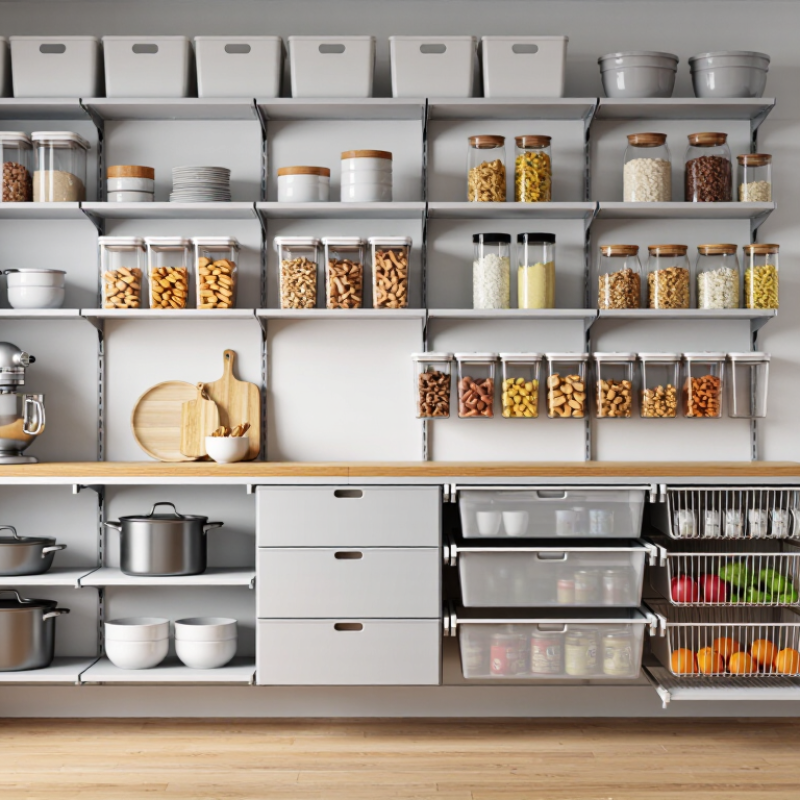
Fixed shelves are sturdy, simple, and often less expensive, but they can waste vertical space when jars and cereal boxes vary in height. Adjustable shelves adapt as pantry habits change. Their weak point is easy to overlook: overloaded brackets may sag, so check the rated capacity before filling them with cans. Houzz’s 2024 U.S. Kitchen Trends Study found that 76% of renovating homeowners included a pantry, underscoring how central storage is to kitchen planning.
Pull-out shelves bring items at the back within reach, especially in deep cabinets. They suit heavy pots or bulk ingredients, though slides need room and can collect crumbs. Wire shelving is light and allows airflow, which can help with produce storage. Small packets and jar lids may tip or slip through, however. No option wins everywhere. The best choice depends on what you store and how often you reach for it.
Tips: Measure the deepest container and the tallest package before choosing shelf spacing. Put everyday items at eye level, and reserve pull-outs for heavy or hard-to-reach goods. Leave a little room for change; pantry layouts rarely stay perfect.
Size Shelf Depths to Common 12-Inch Pantry Storage Modules
For 2026, plan pantry shelves around the items you actually store. A 12-inch module works well as a repeatable width for baskets and pull-out bins, but it does not mean every shelf should be 12 inches deep. Keep everyday cans and jars near the front, where labels stay visible. Shelves about 12 inches deep suit these items; bulkier cereal boxes or small appliances may need 15 to 18 inches. Deeper shelves can hide food at the back. That trade-off is easy to miss on a drawing.
The 2024 U.S. Kitchen Trends Study surveyed 3,437 renovating homeowners and reported that 76% added specialty built-in features. The finding points to strong interest in tailored storage, though it does not establish one ideal shelf depth. Measure your tallest containers, then leave a little clearance above them. Also check door swings, wall irregularities, and the space needed to pull out bins. A neat 12-inch grid can still feel awkward if the shelf edges block access.
Tips: Use 12-inch-wide bins as a starting module, then test one shelf with real groceries before repeating the layout. Mark shelf depths on masking tape. Check what disappears behind a large jar. It happens.
What Is the Best Kitchen Pantry Shelving for 2026? — Size Shelf Depths to Common 12-Inch Pantry Storage Modules
| Shelf Depth |
Best-Suited Storage |
Fit with 12-Inch-Wide Modules |
Practical Considerations |
| 10–12 in (25–30 cm) |
Cans, jars, boxed foods, spices, and everyday pantry items |
Well suited; the shelf depth is close to the module width and keeps items easy to see and reach. |
A versatile choice for most pantry walls. Measure the largest packages you plan to store, including any overhang from doors or trim. |
| 14–16 in (36–41 cm) |
Larger food packages, small appliances, and baskets |
Can work with 12-inch-wide modules, but the shelf will extend farther front-to-back than the module is wide. |
Check aisle clearance and access to items at the back. Consider using pull-out bins or assigning deeper shelves to less frequently used items. |
| 18–20 in (46–51 cm) |
Bulk packages, serving pieces, and larger storage containers |
Usually deeper than a typical 12-inch module; confirm that the cabinet or support system is designed for this depth. |
Items may be harder to reach at the back. Use bins or pull-out shelves to reduce hidden or difficult-to-access storage. |
| 22–24 in (56–61 cm) |
Large bins, countertop appliances, or deep pantry cabinets |
Generally better suited to a deep cabinet or dedicated pantry zone than to a simple 12-inch-wide module. |
Verify shelf load capacity, support spacing, door swing, and walkway clearance. Deep fixed shelves can make small items difficult to locate. |
| 8–10 in (20–25 cm) |
Spices, jars, narrow cans, and shallow wall storage |
Fits comfortably within a 12-inch-wide module and leaves room for a front edge or small containers. |
Useful where reach and visibility matter most, but may not fit bulky packages. Measure items before choosing a shallow shelf. |
Planning note: A 12-inch module usually describes the module’s width, not a required shelf depth. Choose depth based on the items, cabinet dimensions, supports, and available clearance. Measurements are nominal; confirm the usable inside dimensions before ordering or cutting shelves.
Verify Shelf Strength Against ANSI/BIFMA X5.9-2019 Load Tests
What Is the Best Kitchen Pantry Shelving for 2026?
A strong pantry shelf should handle the weight you actually store, not just look sturdy in a product photo. ANSI/BIFMA X5.9-2019 provides performance tests for storage units, but it is not a blanket certification for every kitchen shelf. Ask for test documentation that names the tested unit and configuration. Check whether the stated capacity applies to each shelf or the entire unit. Those numbers are not interchangeable.
Tips: Match test results to your setup. A shelf tested with evenly spread weight may behave differently when jars crowd one edge. Keep heavy cans low, and follow the maker’s guidance on anchoring.
Look closely at how the report describes loading and the unit’s performance. A clear report is more useful than a vague “heavy-duty” claim. Also check shelf material, support spacing, and whether the assembled unit needs a level floor. Lab tests cannot reproduce every kitchen: damp air, repeated bumps, and overloaded corners can change how shelving holds up. I would leave a margin below the listed limit, even when the test looks reassuring. It’s a cautious choice, not a guarantee.
Choose Wood, Metal, or Laminate by Moisture Resistance and Maintenance
What Is the Best Kitchen Pantry Shelving for 2026?
The best pantry shelving depends on moisture and how much upkeep you can manage. A pantry beside a dishwasher, sink, or exterior wall may face damp air and occasional drips. Metal tolerates humidity well, resists swelling, and wipes clean with a damp cloth. Check joints and coating: scratches can expose steel to rust, especially if spills linger. Open wire shelves dry quickly, but small jars may wobble or tip. Small details matter.
Wood feels sturdy and can be cut to fit awkward alcoves. Sealed plywood or hardwood handles ordinary kitchen humidity better than unfinished wood, but standing water can stain or warp it. Wipe spills promptly, and inspect front edges where moisture can seep in. Laminate is easy to clean and often costs less, yet its durability depends on the core and sealed edges. If water gets beneath the surface, particleboard may swell and lose its shape. Not always obvious. For heavy cans, check the shelf’s load rating and support spacing, regardless of material. Metal near plumbing and sealed wood or laminate in a dry pantry can be a practical mix. It may look less uniform. I’d still take that over replacing swollen shelves.