What Is the Best Epoxy Garage Flooring?
Choosing the best Epoxy Garage Flooring system is not simply a matter of picking the shiniest finish.
A garage floor faces hot tires, dropped tools, oil drips, road salt, moisture, and constant temperature changes. The right coating must handle those demands while matching the concrete beneath it. Concrete expert Bob Harris has advised, “Test the product on a small area before committing to the entire floor.” That practical warning remains important because preparation often matters more than the product label.
A durable system usually includes mechanical grinding, crack repair, a suitable epoxy primer, and a protective topcoat. Thin DIY kits may look attractive, but they can peel when moisture rises through the slab. A professionally installed, broadcast-flake floor often provides better texture, appearance, and wear resistance. Still, “professional” does not guarantee perfection. Poor cleaning or rushed curing can ruin an expensive installation.
The ideal choice depends on your garage’s moisture level, traffic, climate, and maintenance habits. Polyaspartic topcoats may cure faster, while high-solids epoxy can provide strong adhesion and rich color. Each option has limitations. That is easy to overlook.
This guide examines coating thickness, surface preparation, slip resistance, chemical durability, installation costs, and long-term value. It also questions common marketing claims, because the cheapest floor is rarely the least expensive mistake. By comparing real performance instead of showroom appearance, homeowners can choose Epoxy Garage Flooring with greater confidence and fewer surprises.
Define “Best” by 2–3 mm DFT, 100% Solids Resin, and Intended Traffic
What Is the Best Epoxy Garage Flooring?
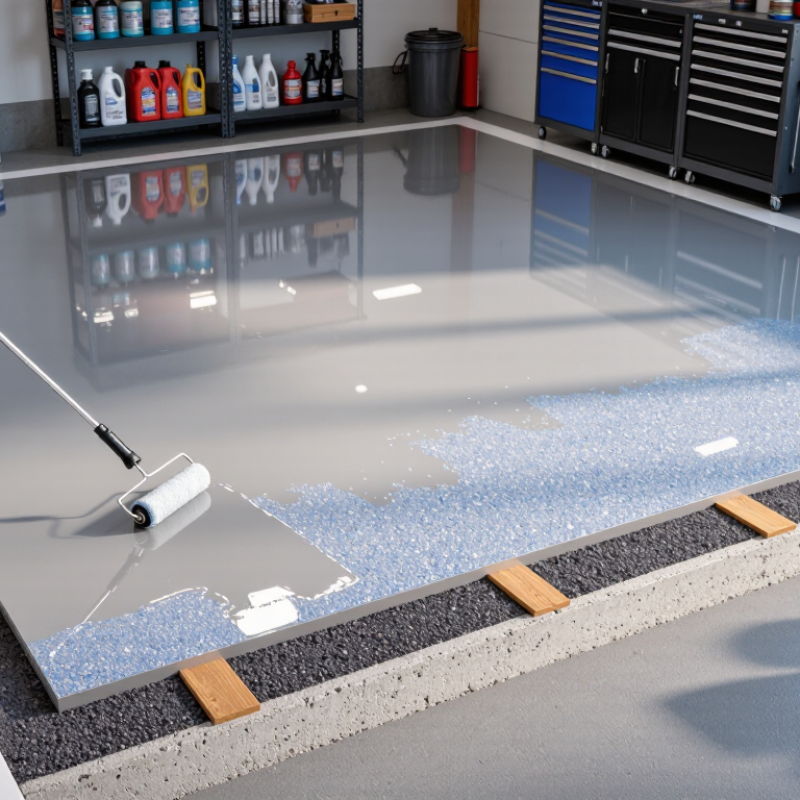
The best epoxy garage floor is defined by performance, not showroom gloss. A practical target is 2–3 mm of dry film thickness (DFT) after curing. This thickness offers better protection against tire wear, dropped tools, and repeated cleaning. Thin coatings may look attractive but can expose concrete quickly. Measure coverage carefully. Guesswork often creates weak areas.
Choose a 100% solids epoxy resin when durability matters. It contains little or no evaporating solvent, so the cured film retains its designed thickness. However, resin alone cannot repair poor preparation. The concrete should be mechanically profiled, clean, dry, and free from oil. Moisture testing is essential, especially near garage doors or older slabs. Small cracks also need suitable repair before coating.
Traffic should determine the system. A private garage with passenger vehicles may need a different finish than a workshop with heavy jacks, carts, or frequent chemical exposure. Add slip-resistant aggregate where water or snow enters. I have seen smooth floors become unexpectedly hazardous after one wet winter. Even well-specified floors can fail when application conditions are ignored. Cool temperatures, high humidity, or rushed recoating may leave soft or cloudy areas. Check the actual DFT, curing time, and expected traffic before accepting the finished surface.
Compare Water-, Solvent-, and 100%-Solids Epoxy by VOC and Cure Time
What Is the Best Epoxy Garage Flooring?
Water-based epoxy usually offers the lowest odor and lower VOC levels among three common options. It spreads easily and cleans up with water, making it practical for occupied homes. However, the coating is often thinner and less forgiving on rough concrete. Light foot traffic may be possible after 24 hours, while vehicle use commonly requires three to seven days. Temperature and humidity can extend that window.
Solvent-based epoxy contains more VOCs and produces a stronger smell during application. Good ventilation and suitable protective equipment are essential. It often wets concrete better than water-based coatings and can cure faster, sometimes allowing foot traffic within 12 to 24 hours. Vehicle traffic may still need three to five days. Never judge readiness by surface dryness alone.
100%-solids epoxy contains little or no solvent, so its VOC profile is usually the lowest. It creates a thicker, tougher film, but it has a short working time after mixing. Concrete preparation must be excellent. A dusty slab or hidden moisture can cause peeling, regardless of the product type. I once treated a manufacturer’s cure time as a promise; that was too simplistic. Garage temperatures change quickly, especially near doors. A small test area, moisture check, and one extra curing day are sensible safeguards. The “best” system depends on ventilation, traffic, slab condition, and how patiently the floor can remain unused.
What Is the Best Epoxy Garage Flooring? Compare Water-, Solvent-, and 100%-Solids Epoxy by VOC and Cure Time
| Epoxy System |
Typical VOC Range |
Recommended Application Thickness |
Pot Life at 70°F (21°C) |
Typical Recoat Time |
Light Foot Traffic |
Vehicle Traffic / Full Cure |
Key Advantages |
Primary Limitations |
Best Use in a Garage |
| Water-Based Epoxy |
Approximately 100–250 g/L, depending on formulation |
About 4–8 mils dry film thickness per coat |
Approximately 30–60 minutes |
Typically 4–8 hours |
Usually 12–24 hours |
Usually 3–7 days for regular vehicle use and full chemical resistance |
Lowest odor of the three categories; easier cleanup with water; generally easier for indoor residential application |
Usually thinner and less abrasion-resistant than high-solids systems; moisture and cool temperatures can extend drying time |
Garages where ventilation is limited and a lower-odor coating is preferred |
| Solvent-Based Epoxy |
Approximately 250–450 g/L, depending on formulation and local regulations |
About 6–12 mils dry film thickness per coat |
Approximately 30–60 minutes |
Typically 8–12 hours |
Usually 12–24 hours |
Usually 3–7 days for regular vehicle use and full chemical resistance |
Good flow and wetting of concrete; can tolerate some surface imperfections better than water-based coatings; often provides a durable finish |
Higher odor and VOC emissions; requires strong ventilation and careful control of ignition sources during application |
Well-ventilated garages where penetration and application tolerance are important |
| 100%-Solids Epoxy |
Typically 0–50 g/L; some formulations are marketed as zero-VOC, but the actual value depends on the product |
About 10–20 mils dry film thickness per coat; commonly used for thicker build systems |
Approximately 20–45 minutes |
Typically 6–12 hours |
Usually 12–24 hours |
Usually 3–7 days for regular vehicle use and full chemical resistance |
Very high build, excellent abrasion resistance, strong chemical resistance, and little or no solvent evaporation during curing |
Shorter working time; requires careful surface preparation and accurate mixing; moisture, temperature, and concrete conditions strongly affect results |
High-traffic garages requiring maximum durability and a thicker protective coating |
Practical conclusion: 100%-solids epoxy is generally the best choice for maximum garage durability and the lowest VOC level. Water-based epoxy is usually the better option when low odor and easier application are priorities. Solvent-based epoxy can provide good penetration and flow, but it normally has the highest VOC emissions and requires the most ventilation. Actual VOC content and cure times vary by formulation, film thickness, concrete temperature, humidity, and manufacturer instructions.
Qualify the Slab: ASTM F2170 RH ≤75% and MVER ≤3 lb/1,000 ft²/24 h
What Is the Best Epoxy Garage Flooring?
The best epoxy garage floor begins with a qualified concrete slab, not a color chart. Before coating, test internal moisture using ASTM F2170 in-situ relative humidity probes. For many epoxy systems, the reading should be 75% RH or lower. Test several locations, especially near walls, doors, drains, and visibly repaired areas. One reading is not enough.
Also measure moisture vapor emission using a calcium-chloride test. A common acceptance limit is 3 pounds per 1,000 square feet over 24 hours, written as 3 lb/1,000 ft²/24 h. Keep the slab temperature stable during testing. Record surface temperature, room humidity, test duration, and exact locations. These details make the result traceable and more useful.
A slab can look dry and still hold dangerous moisture. I have seen clean concrete develop cloudy patches, bubbles, or loose coating after installation. The mistake was trusting appearance. Still, these limits are not universal; always compare them with the selected epoxy system’s technical requirements. If readings exceed the limit, pause the project. Improve ventilation, allow more drying time, or consult a qualified flooring professional. Do not simply add primer and hope. That shortcut can hide the problem, not solve it. Some older slabs also produce uneven results, so retesting may be wise after preparation.
Rank Durability with ASTM D4060 Wear, D4541 Adhesion, and Load Ratings
What is the best epoxy garage flooring? Durability should be ranked with test evidence, not gloss or color. ASTM D4060 measures abrasion through mass loss after controlled Taber cycles. Lower loss indicates better wear resistance. However, results depend on wheel type, load, cycle count, and coating thickness. A report without these details is weak evidence.
ASTM D4541 measures pull-off adhesion in MPa. Higher strength is useful, but the failure location matters more than one impressive number. Cohesive failure in the concrete can suggest strong bonding. Adhesive failure at the coating interface signals preparation problems. Field inspections often find dust, moisture, or laitance beneath otherwise attractive floors. Surface preparation remains critical.
Load ratings need separate attention.
A garage floor may experience vehicle tires, jacks, dropped tools, and narrow caster wheels. ACI 360R, Guide to Design of Slabs-on-Ground, evaluates slab behavior under applied loads; the coating itself cannot repair weak concrete. Ask for the complete load rating, including point-load assumptions and substrate condition.
A practical comparison should record ASTM D4060 loss, ASTM D4541 strength, coating thickness, and supported loads. Be cautious with simple rankings. The “best” system can still fail when moisture rises through the slab or joints move. That part is easy to overlook.